
Skip to content
Oolite Solar & BatteryOoliteSolar & Battery
Home batteries

Store your daytime solar. Use it at night.

Already have solar? A battery can store some of your spare daytime power for the evening. If you also want power during a blackout, we can quote a separate backup set-up for chosen circuits.

Six sizes, fitted

  • 19 kWhfrom $5,290
  • 28 kWhfrom $5,990
  • 33 kWhfrom $6,890
  • 42 kWhfrom $8,690
  • 49 kWhfrom $10,890
  • 56 kWhfrom $12,590

These prices are a guide. The brand you choose and your home change the final price. Why does a bigger battery cost only a bit more? The government rebate pays the most on the first 14 kWh of a battery, less up to 28 kWh, and a little up to 50 kWh. Fitted, GST included, rebate already taken off. Blackout backup, switchboard upgrades and three-phase upgrades are not included; if your home needs them, we show the cost in writing before you agree. How the rebate works →

A battery for the solar you have, fitted

from$5,990

28 kWh · a guide price · rebate already taken off

  • We check your inverter and switchboard first
  • Your panels stay, if they suit
  • Blackout backup: optional, from $690 extra

No solar yet? Panels and a battery from $9,690 →

Licensed NSW electricians (502959C)SAA accreditedYou deal with the owners who run every job

Our own work

Batteries we added to existing solar

Two homes that already had panels. We added the battery.

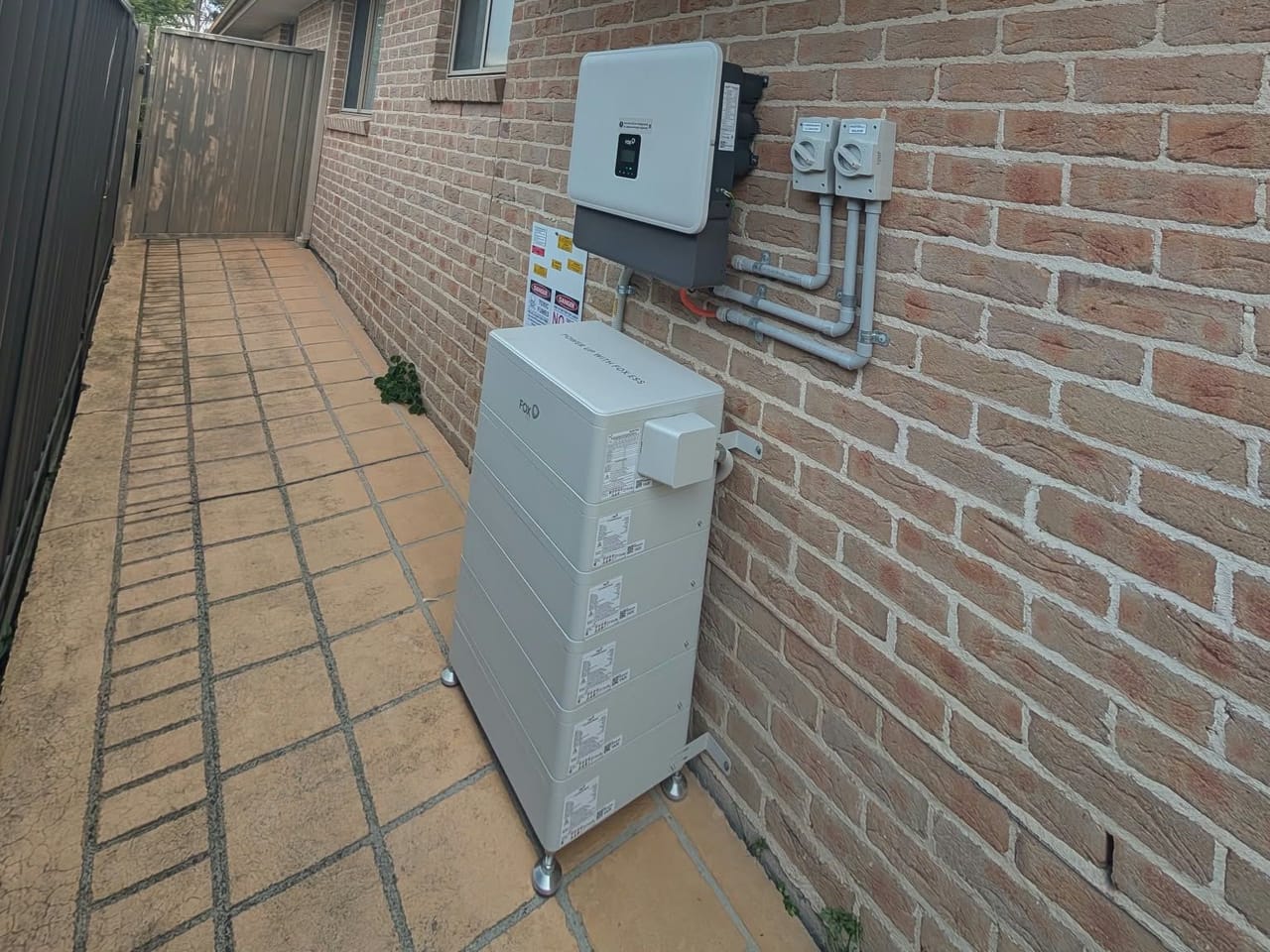
A 27.96 kWh Fox ESS EQ4800 battery and a 9.9 kW Fox ESS inverter on a brick side wall in Pendle Hill NSW.Pendle Hill
Battery

A battery added to the solar they already had

  • 28 kWh battery
  • Kept their 5 kW solar
  • Blackout backup

Fitted by our own licensed electricians.
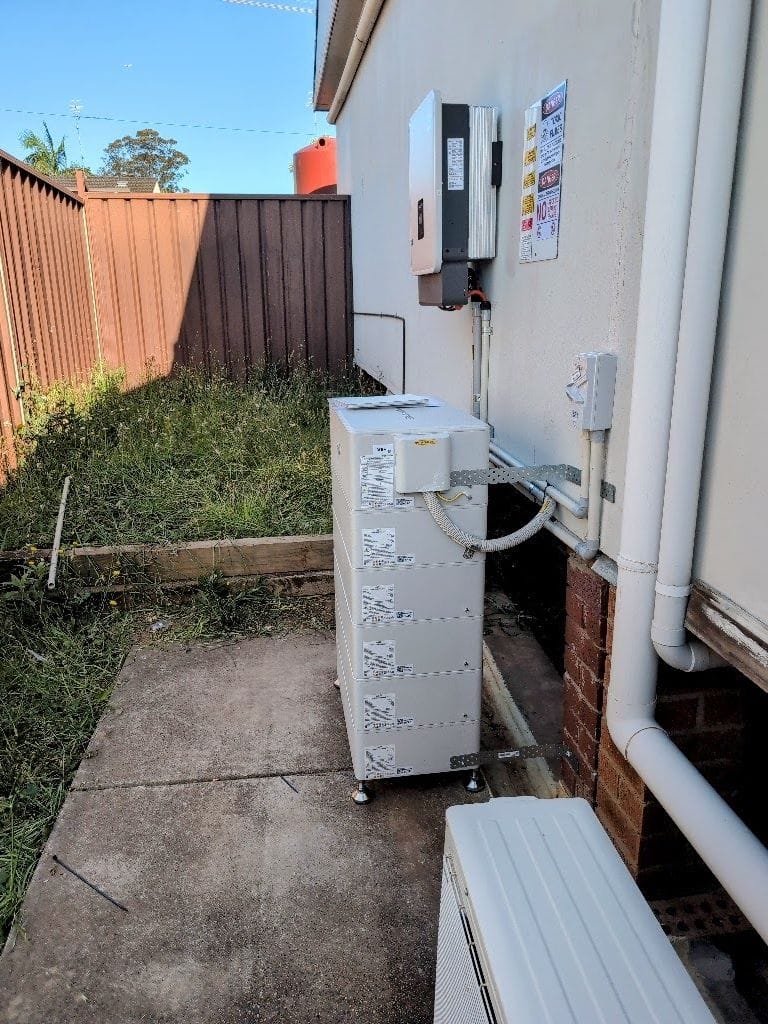
A 41.76 kWh Fox ESS CQ7 battery and a 9.9 kW Fox ESS inverter on an outside wall in Greystanes NSW.Greystanes
Battery

A big battery added to the solar they already had

  • 42 kWh battery
  • New 9.9 kW inverter
  • Kept their 12 kW of panels

Fitted by our own licensed electricians.

Swipe to see the next home →

See all our work →

What can your battery keep running in a blackout?

Backup is an optional extra. We choose which circuits to connect and check how much power the system can supply. A bigger battery stores more energy, but it doesn't power every appliance by itself.

Common backup choices

  • Fridge
  • Chosen lights
  • Wi-Fi + a few power points
  • Phone chargers

Usually needs extra planning

  • … Ducted air-con
  • … Oven
  • … EV charger
  • … Pool pump

Backup is not in the price. It needs a backup switch and its own wiring. Without it, a battery shuts down in a blackout like everything else. That is a safety rule, so the inverter cannot push power into a line someone might be working on.

A bigger battery gives more hours, not more appliances. Your actual backup depends on the inverter, battery, wiring and the appliances connected. More about backup →

Is a battery worth it for your home?

If you use plenty of power after sunset and have spare solar during the day, a battery may cut what you buy from the grid. We check your bill and your system before we suggest a size. If the numbers don't add up, we'll tell you.

What we ask about first
  • • The sticker on the side of your inverter (its brand and size).
  • • Your switchboard (how much room it has).
  • • A recent power bill.

That is usually enough for a first answer. We aim to call you back the same or next working day (Mon–Sat, 7am–5pm).

How you can check us before you sign

  • Licensed in NSW: contractor licence 502959C and supervisor licence 358421C.
  • SAA accredited for batteries, which your rebate needs.
  • You deal directly with our team. Our own electricians do the install.
  • 8 Google reviews, 5.0 stars. Read them →
What the government found when it checked battery installs →

Of 4,322 battery installs the regulator inspected (to 30 September 2026), 59.72% had at least one item not to the rules but were safe to keep running, and 0.86% were unsafe.

Some installs were picked at random and some were targeted, and the regulator says it is too early for firm conclusions. The most common problem it found was labelling.

Source: Clean Energy Regulator, Solar battery inspection results report (last updated 12 November 2026). Read it — we checked it on 13 November 2026.

Should you join a VPP?

A VPP (Virtual Power Plant) lets a power company use a little of your battery when the grid is under pressure, like a hot summer evening. They pay you for it. You can join one and still get the government battery rebate.

The one question to ask any VPP:“Do you ever fill my battery from the grid?” If yes, you can end up paying for power you did not use. Get the answer in writing before you sign.

The good side and the catch →

✅ The good side

  • •Extra money coming in. How much depends on the plan, so we work out a real number for your set-up.
  • •There may be a NSW payment on top, though the amount changes from company to company.
  • •You help the grid on the worst days, and still keep some power set aside for yourself.

⚠️ The catch

  • •Your battery wears a little faster — a few extra fill-ups a year.
  • •You lose some control. They may use part of your battery before an evening you wanted it full.
  • •Some batteries count the warranty differently once you join a VPP. Check before you sign.

Common questions

How much does a home battery cost?
Already have solar? A battery added to your system starts at about $5,290 for 19 kWh, $5,990 for 28 kWh, $6,890 for 33 kWh, $8,690 for 42 kWh, $10,890 for 49 kWh, $12,590 for 56 kWh, fitted, with the government discount already off. Need panels too? 6.65 kW of panels with a 28 kWh battery starts at about $9,690. Your exact price depends on your switchboard and where the battery goes. All prices include GST.
Where does the battery go?
Usually on an outside wall, in the shade, near your switchboard. About the size of a small bookcase. It makes a quiet hum, like a fridge. We pick the spot with you before we start.
Will a battery keep my house on in a blackout?
Only if you buy the backup gear too. Many batteries switch off with the grid unless you add a backup switch and its own wiring. We tell you exactly what your set-up would do before you buy, not after.
How long does a battery last?
About 10 to 15 years. Do not just look at the 10-year sticker. What really matters is how much power it can push out over its whole life, and how much you use each day. We only fit batteries from the government-approved list.
Is there a rebate on batteries?
Yes. If your battery fits the rules, the government takes money off the price up front. How the rebate works.
Can I add a battery to the solar I already have?
Often yes. We check your inverter and your switchboard, then tell you what is involved and what it costs.

💳 Asking about the NSW 0% loan? See what it needs.

🏢 Live in a unit or an apartment block? There is a NSW rebate for one shared battery for the whole building. See the rebate for units →

Worth knowing before you buy

You may see ads for "free solar" or "rebate ending soon". We don't use them. It is not free, and it only gets smaller slowly, so there is no need to rush. We show you the real number for your home and let you decide in your own time.

  • We won’t door-knock you.
  • Our electricians handle your solar and battery installation. If your street connection needs a specialist, we tell you who will do it before you agree.
  • After the install, you call us, not a call centre.

Want to know what your place would keep running?

Tell us your suburb and roughly what your bill is, and we'll give you a straight answer. No pressure.

We aim to call you back the same or next working day (Mon–Sat, 7am–5pm).

0433 681 002Get my price